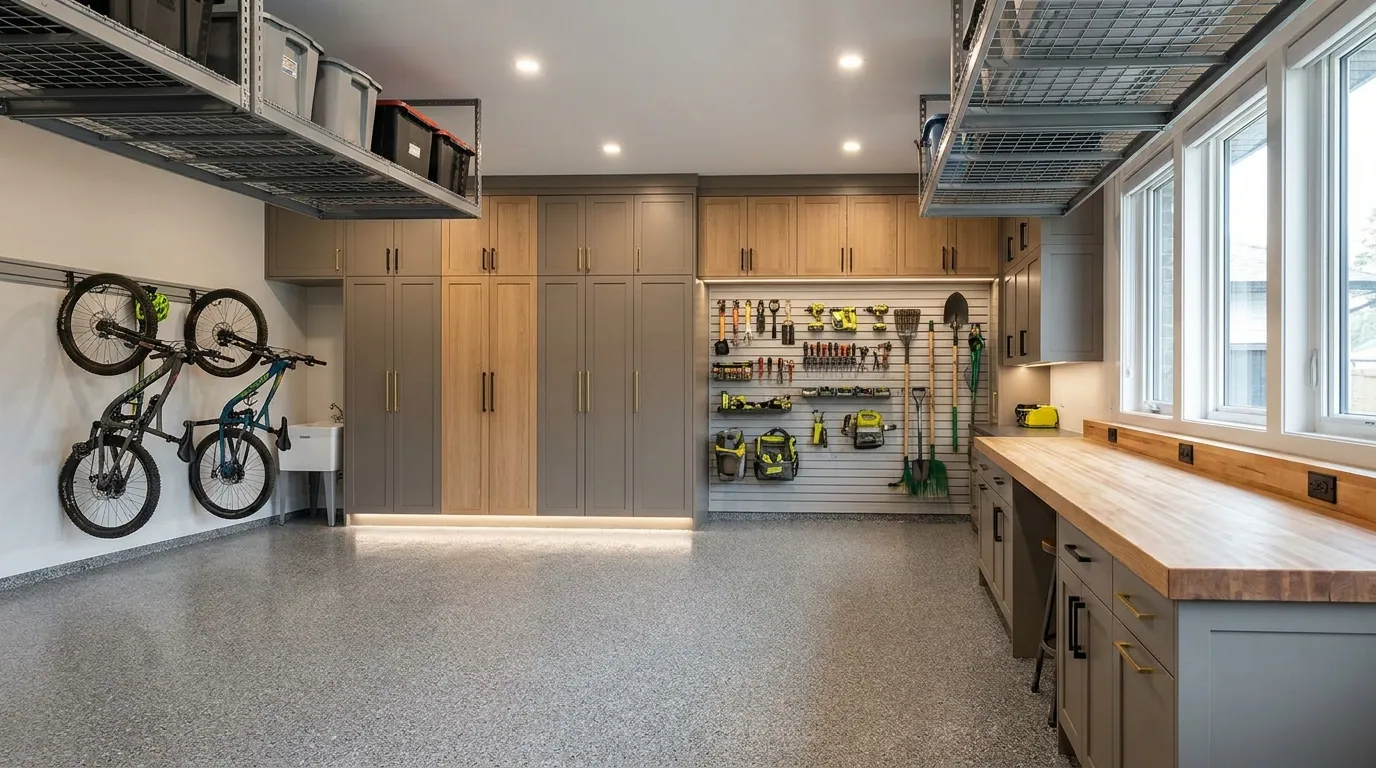
For most homeowners in the Fraser Valley & Lower Mainland, the garage quietly becomes the default home for everything that doesn't have a place — bikes, seasonal decorations, sports gear, tools, and the overflow from every other room in the house. A well-designed garage storage system turns that chaos back into usable space, and holds up to BC's wet winters while it's at it.
Cabinets vs. Open Shelving
Both have a place in a well-planned garage, and most projects use a mix of the two:
- Closed cabinets keep dust, pests and moisture off stored items, and hide clutter behind clean doors — ideal for anything you don't need to see or grab quickly, like chemicals, off-season gear or documents.
- Open shelving gives faster access for things you reach for often — bins of sports equipment, recycling supplies, or garden tools — and is generally a lower-cost way to add storage volume quickly.
A good rule of thumb: cabinets for anything you want protected or out of sight, open shelving for anything you want fast access to.
Slatwall Systems for Tools & Gear
Slatwall panels turn an entire wall into flexible, adjustable storage using hooks, baskets and bins that reposition in seconds — no new holes to patch every time your storage needs change. It's especially useful for hand tools, sports gear, extension cords and anything with an awkward shape that doesn't stack neatly on a shelf.
Install slatwall at a height that clears your vehicle doors when fully open — a common mistake is mounting it too low, which means you're reaching around an open car door every time you grab something.
Overhead Storage for Seasonal Items
Ceiling-mounted racks reclaim one of the most underused areas of a garage — the space above your vehicle's roofline. It's ideal for holiday decorations, camping gear, luggage and anything else you only need a few times a year. Just make sure overhead storage is rated for the weight you're planning to store, and leave clearance for garage door tracks and openers.
Moisture & Wet-Coast Considerations
Garages in Chilliwack, Abbotsford, Maple Ridge and across the Fraser Valley deal with a real challenge most drier climates don't: sustained damp winters, plus the salt, sand and slush that come in on vehicles and boots for months at a time. Condensation is also common in an unheated garage once temperatures swing between a cold morning and a warmer afternoon, and that moisture ends up on anything sitting directly against a concrete floor or exterior wall. A few things we account for in every BC garage project:
- Cabinetry raised off the slab rather than sitting flush on concrete, reducing moisture wicking into the base of the unit.
- Moisture-resistant panel materials rather than raw particleboard, which swells and delaminates when it gets damp.
- Slatwall or open shelving (rather than sealed cabinets) for wet gear like ski boots, rain jackets and boots, so items can air out instead of trapping moisture.
Plan in Zones, Not Just Storage Units
The garages that stay organized long-term are usually planned in zones rather than as one big storage problem. A simple zone layout we recommend to most homeowners:
- Parking zone — kept clear, with nothing stored on the floor that isn't on wheels.
- Tool & workbench zone — usually along one side wall, closest to an outlet.
- Sports & recreation zone — bikes, helmets and seasonal equipment near the door you actually use to head out.
- Seasonal & overhead zone — holiday decorations and rarely-used items, stored up and out of the way.
Mapping these zones out before cabinetry goes in — rather than buying storage piece by piece over the years — is what keeps a garage from slowly refilling with clutter after the first big clean-out.
Storing Bikes, Tools & Sports Gear
Bikes are one of the trickiest garage items — bulky, awkward to stack, and often needed on short notice. Wall-mounted hooks or a dedicated vertical rack keep bikes off the floor entirely, freeing up parking space without making them hard to grab for a weekend ride. Pair that with labelled bins for helmets, pads and seasonal sports equipment (soccer gear in spring, ski gear in winter) so everything has an obvious home.
Adding a Workbench That Doesn't Eat Your Space
A built-in workbench with cabinetry underneath gives you a dedicated work surface for projects and repairs, while the base cabinets absorb tools, hardware and supplies that would otherwise end up in bins on the floor. Folding or wall-mounted bench designs are worth considering in smaller garages where you still want to park two vehicles day-to-day.
Plan your workbench location near an existing outlet, or budget for an electrician to add one — it's a lot cheaper to plan for power tools and lighting before cabinetry goes in than to retrofit around it later.
Ready to Reclaim Your Garage?
A garage that actually works — with parking, storage and a workbench all coexisting — starts with a plan built around how you use the space. We've designed garage systems for homes across Maple Ridge, Chilliwack and the wider Fraser Valley & Lower Mainland. Book a free in-home consultation and we'll design your layout in 3D — call (604) 316-5289 to get started.